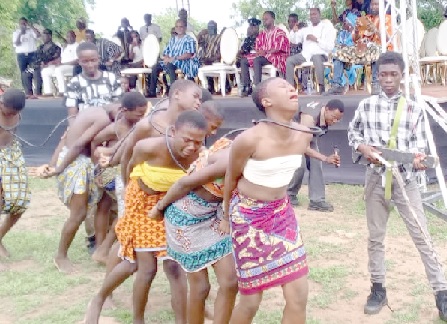
The cries of terrified children, the desperate pleas of separated families and the painful reality of human beings being treated as commodities echoed through the historic Pikworo Slave Camp at Paga as pupils of ROVECA Preparatory School recreated one of Africa’s darkest chapters, the transatlantic slave trade.
Through an agonising blend of poetry and drama during the 2026 Emancipation Day celebration on Tuesday, July 21, 2026, the pupils transformed the sacred grounds into a living theatre, portraying how Africans were captured, chained, inspected, priced and sold during the era of slavery.
As one group of pupils acted as slave raiders, others played the role of helpless captives, depicting families torn apart, mothers losing their children and young men and women being reduced to property for trade.
‘Priced and bought’
Through a poem titled “Fathers Gather Little Ones,” the pupils narrated the painful experiences of Africans who were captured and forced into slavery.
“The raiders came with fire. They came with chains. They came with greed. Homes burned. Granaries collapsed. The sons of peasants vanished,” they recited.
“The strong were taken, not because they committed a crime, but because they were human beings designed as property,” the pupils recited.
Celebrating resilience
Speaking on behalf of the Chief Executive Officer of the Ghana Tourism Authority (GTA), Maame Efua Houadjeto, the Director of Marketing at GTA, Wisdom Ahadzi,said the day was not only a reminder of Africa’s painful past but also a celebration of resilience, courage and survival.
He described the heritage sites such as the Pikworo Slave Camp as important connections between Africans on the continent and the diaspora, helping to strengthen cultural identity and unity.
Call against African division
The Executive Chairman of the African Tourism Board (ATB), Cuthbert Ncube, expressed concern about developments that threaten African unity, particularly xenophobic attacks and anti-immigrant sentiments.
Speaking as a South African, he condemned violence and discrimination against Africans in South Africa, describing such acts as a betrayal of the collective struggle that helped liberate the country.

He said Africa could not celebrate Pan-Africanism while allowing divisions that forced Africans to turn against one another.
He urged traditional leaders to take an active role in protecting unity and guiding political leaders whenever they failed to uphold the dignity of Africans.
“Our traditional leaders cannot afford to be passive spectators in a time of cultural and political crisis,” he said.
He described unemployment, unfair labour practices, human trafficking, and desperate migration as some of the modern forms of slavery affecting young people.
Mr Aborah said many young graduates were trapped in cycles of frustration after paying application fees for jobs that offered little hope of employment, and called for reforms to make recruitment processes more transparent and fair.
Assurance
The Upper East Regional Minister, Donatus Akamugri Atanga, commended the Paga Youth Movement and the Ghana Tourism Authority for their commitment to preserving the Pikworo Slave Camp and promoting tourism in the region.
He said the government was committed to creating an enabling environment for the youth and urged stakeholders to use the painful memories associated with the former slave camp as inspiration to build a future anchored on unity, resilience, justice, and shared prosperity rather than dwell on the injustices of the past.
By Gilbert Azeem Tiroog, Graphic Online